
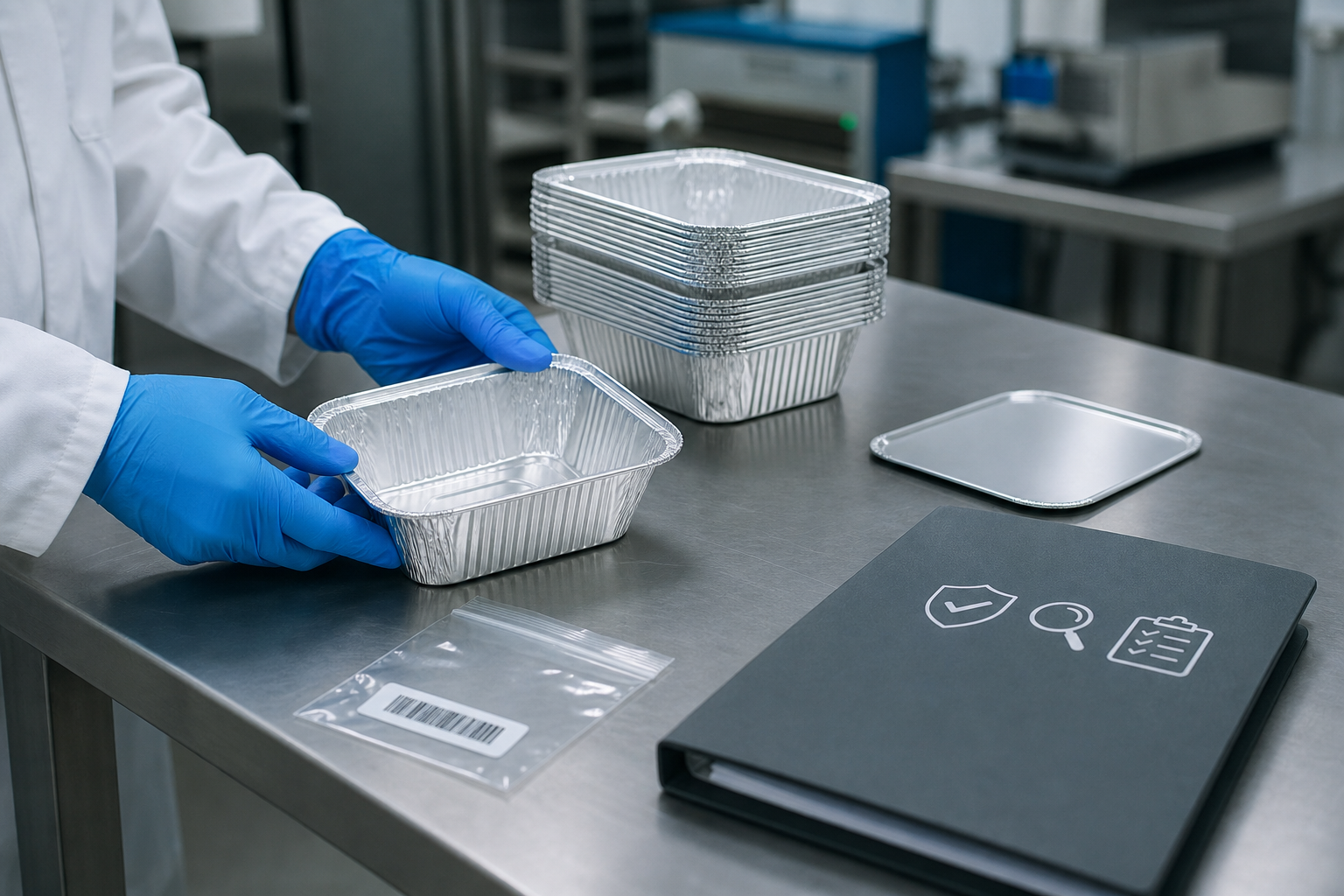
Un dossier documentaire de contact alimentaire pour des barquettes en aluminium doit aider l’importateur à répondre à une question essentielle : cette barquette peut-elle être commercialisée pour l’aliment, le marché et l’usage prévus ? Demandez la spécification du produit, l’alliage et la plage d’épaisseur, les rapports d’essai ou déclarations de contact alimentaire, les caractéristiques du couvercle correspondant, les dossiers d’échantillons, les marquages des cartons et les données de conditionnement avant de valider une commande en volume.
L’actualité de l’emballage reste riche en discussions sur le contact alimentaire et la responsabilité élargie du producteur (REP), mais un importateur a généralement besoin de quelque chose de plus concret qu’un titre de presse. Le travail utile se fait dans le dossier de demande de prix : faire correspondre le contenant, le couvercle, le type d’aliment, le marché, les documents d’essai et les pièces d’expédition avant de s’engager financièrement.
Cette liste s’adresse aux importateurs, distributeurs, acheteurs d’emballages alimentaires à marque de distributeur et grossistes pour la restauration qui évaluent des barquettes en aluminium proposées par un fournisseur étranger. Elle ne constitue pas un avis juridique. Les règles locales restent importantes. Elle vise à clarifier les échanges avec le fournisseur et à réduire le risque de devoir réclamer des documents manquants une fois la production commencée.
Commencer par la spécification exacte du produit
Ne demandez pas des documents pour un article décrit vaguement comme une barquette ou une boîte en aluminium. Demandez au fournisseur de rattacher chaque document à une spécification précise. Le dossier doit indiquer la forme, les dimensions extérieures en partie haute, les dimensions du fond, la hauteur, la capacité, le profil du bord, le type de parois, l’alliage et l’état métallurgique s’ils sont disponibles, l’épaisseur ou le poids cible, la finition de surface et le couvercle prévu.
Pour les barquettes en aluminium, de petites différences peuvent compter. Une barquette à parois lisses avec un film thermoscellable ne relève pas du même dossier d’achat qu’une barquette à parois plissées pour plats à emporter avec un couvercle en carton. Une barquette laquée pour des aliments acides ou salés ne doit pas être traitée comme une barquette en aluminium non revêtu utilisée pour des produits de boulangerie-pâtisserie.
Au stade de la demande de prix, demandez au fournisseur de confirmer :
- le plan ou la fiche dimensionnelle du contenant
- le matériau et la finition de surface
- l’épaisseur ou le poids cible de la barquette
- le type et le matériau du couvercle
- l’usage prévu : boulangerie-pâtisserie, vente à emporter, repas à bord d’avions, restauration, congélation ou chauffage au four, par exemple
- la méthode de conditionnement, le sachet intérieur, le nombre de pièces par carton et le plan de palettisation
Si le fournisseur envoie un ancien certificat couvrant toute l’usine sans pouvoir le relier à l’article acheté, poursuivez vos questions. Un certificat d’usine peut être utile comme information générale, mais ne remplace pas des éléments probants propres au produit.
Demander les rapports d’essai ou les déclarations de contact alimentaire
La liste de sources FDA sur le contact alimentaire citée dans le dernier bulletin de veille renvoie à des recommandations et inventaires officiels sur les emballages et les substances au contact des aliments. Les sources européennes restent également utiles pour comparer la documentation. Pour les achats, l’essentiel est simple : votre fournisseur doit savoir quels documents de contact alimentaire sont pertinents pour votre marché de destination et votre type de produit.
Pour les barquettes en aluminium, les importateurs demandent couramment un ou plusieurs des éléments suivants, selon le marché et leur propre procédure de conformité :
- rapport d’essai de contact alimentaire pour le matériau ou l’article fini
- déclaration de conformité ou déclaration du fournisseur, le cas échéant
- rapport d’essai sur les métaux lourds ou certaines substances lorsque le marché l’exige
- informations sur le revêtement ou la laque si la barquette est revêtue
- informations sur les essais de migration lorsque l’usage prévu le nécessite
- références BRCGS, ISO, SGS ou similaires concernant l’usine et les essais, si disponibles
Ne transformez pas cette démarche en chasse aux logos. L’acheteur a besoin de documents correspondant au produit, au matériau et au marché. Un fournisseur peut disposer d’un bon audit d’usine tout en ayant besoin d’un rapport d’essai produit distinct pour un nouveau matériau, revêtement, marquage imprimé ou assemblage avec un couvercle.
Vérifier que le document correspond à la barquette achetée
C’est ici que de nombreux dossiers d’achat perdent en cohérence. Le document arrive, chacun voit le logo d’un laboratoire, puis l’acheteur passe à la suite. Prenez cinq minutes. Comparez le rapport à la demande de prix.
Vérifiez les éléments suivants avant d’accepter le dossier documentaire :
- raison sociale et nom de l’usine
- description de l’échantillon
- description du matériau
- date du rapport et exigences de votre client concernant sa validité
- référence de la norme d’essai ou du règlement
- pages de résultats, et pas seulement la couverture
- nature de l’échantillon testé : aluminium non revêtu, aluminium revêtu, matériau imprimé, matériau du couvercle ou barquette finie
- langue du rapport acceptable pour votre client ou l’autorité concernée
Si le rapport mentionne une feuille d’aluminium alors que votre commande porte sur une barquette noire et dorée revêtue pour repas à bord, demandez si le revêtement est couvert. Si le rapport concerne un rouleau d’aluminium mais que vous commandez des contenants formés avec un couvercle thermoscellable, demandez quels justificatifs couvrent le couvercle et la couche de scellage.
Relier le type d’aliment et les conditions d’utilisation aux documents demandés
Une liste de documents ne doit pas être copiée aveuglément d’une commande à l’autre. L’aliment et les conditions d’utilisation modifient le risque. Les produits secs de boulangerie-pâtisserie, les plats préparés, les aliments gras, les sauces acides, les aliments salés, les plats surgelés et les plats réchauffés au four peuvent nécessiter des vérifications différentes.
Avant de demander les documents, décrivez simplement l’usage au fournisseur. Par exemple : plats préparés surgelés réchauffés au four, riz en sauce à emporter, gâteaux exposés en magasin, plateaux-repas pour l’aviation ou bacs de traiteur pour maintien au chaud. Cela l’aide à déterminer s’il faut discuter d’aluminium non revêtu ou revêtu, d’un scellage par film ou d’un autre couvercle.
Pour les aliments en sauce, acides ou salés, ne vous contentez pas d’un devis générique. Demandez si des barquettes en aluminium laqué sont recommandées et si les caractéristiques du revêtement peuvent être documentées. Si les aliments restent longtemps au contact de la barquette, précisez-le clairement.
Inclure les couvercles, les étiquettes et les matériaux de conditionnement
Le contenant n’est qu’un élément du pack vendu. Les importateurs ont souvent besoin de justificatifs ou de spécifications pour les couvercles, les étiquettes, les fourreaux imprimés, les marquages des cartons, les sachets intérieurs et les emballages de vente. Un couvercle transparent peut relever d’exigences concernant les plastiques. Un couvercle en carton peut nécessiter des informations sur le carton et son revêtement. Un film thermoscellable possède ses propres caractéristiques de matériau et de scellage.
Demandez des informations distinctes lorsque la commande comprend :
- des couvercles en carton
- des couvercles clipsables en plastique
- des couvercles en feuille d’aluminium
- du film thermoscellable
- des étiquettes ou fourreaux imprimés
- des boîtes imprimées en couleur ou des cartons à marque de distributeur
- des sachets intérieurs en contact avec l’article destiné au contact alimentaire
C’est particulièrement important pour les marques de distributeur et l’approvisionnement des supermarchés. L’équipe conformité de l’acheteur peut accorder autant d’attention au couvercle et à l’étiquette qu’à la barquette elle-même.
Préparer le dossier de demande de prix avant le devis
Une demande de prix claire fait gagner du temps : le fournisseur peut chiffrer le bon produit sans deviner. Pour les commandes aux exigences documentaires importantes, ajoutez une courte rubrique de conformité. Vous n’avez pas besoin d’un long paragraphe juridique, mais de questions précises.
Une note utile peut être aussi directe que ceci :
- Marché de destination : États-Unis, UE, Royaume-Uni, pays du CCG ou autre marché
- Type d’aliment : produits secs de boulangerie-pâtisserie, repas chaud, sauce acide, plat surgelé, restauration ou autre usage
- Conditions d’utilisation : congélation, four, réchauffage, livraison, rayon de vente ou service de courte durée
- Documents demandés : rapport de contact alimentaire, déclaration, référence d’audit d’usine, informations sur le revêtement et documents relatifs au matériau du couvercle
- Échantillons demandés : barquette finie, couvercle, étiquette du carton et photo du conditionnement
Envoyez ces informations avant d’aller trop loin dans la négociation du prix. Si le fournisseur ne peut pas répondre aux questions documentaires, vous le saurez tôt. S’il y répond clairement, le devis sera plus facile à comparer.
Comparer les échantillons aux documents
Ne séparez pas les documents des échantillons dans vos dossiers. À la réception, comparez ce que vous pouvez observer physiquement aux documents. Vérifiez les dimensions, la forme du bord, l’ajustement du couvercle, la résistance des parois, la finition de surface, l’impression, les marquages des cartons et le conditionnement intérieur. Prenez des photos et conservez-les avec les rapports.
Pour les barquettes en aluminium, l’examen des échantillons devrait comprendre :
- la vérification du poids ou de l’épaisseur lorsque c’est possible
- l’ajustement du couvercle et l’empilage
- la résistance du bord et la déformation
- la finition de surface, surtout pour les barquettes revêtues
- la quantité par carton et la protection du conditionnement
- l’étiquette de l’échantillon ou la référence du lot
Cela ne remplace pas les essais de laboratoire. Cela évite des erreurs d’achat élémentaires. Si le rapport couvre un produit mais que l’échantillon semble différent, demandez des précisions avant la production.
Repérer les signaux d’alerte documentaires
La plupart des problèmes ne sont pas spectaculaires. Ce sont de petits écarts qui deviennent urgents plus tard. Considérez les situations suivantes comme des avertissements :
- nom de l’échantillon trop vague dans le rapport
- rapport concernant un autre matériau ou couvercle
- fournisseur n’envoyant que la page de couverture du certificat
- dates anciennes alors que le client exige des rapports plus récents
- raison sociale différente de celle de l’usine ou de l’exportateur ayant établi le devis
- norme d’essai non pertinente pour le marché de destination
- revêtement ou impression non mentionné alors que la commande en comporte
- fournisseur incapable d’expliquer quel document couvre quel article
Un bon fournisseur n’a pas besoin d’avoir immédiatement tous les documents pour tous les marchés possibles. En revanche, il doit comprendre la question, expliquer ce qui existe et préciser ce qui nécessite de nouveaux essais.
Comment les acheteurs FirstAlu peuvent organiser leur demande
Pour un premier échange, précisez d’abord l’usage et le marché, puis demandez la liste des documents correspondants. Les pages produits publiques de FirstAlu peuvent aider à cibler le type de contenant avant l’examen documentaire. Voici des points de départ utiles : /products/aluminum-foil/container, /products/aluminum-foil/aluminum-foil-container-smoothwall, /products/aluminum-foil/aluminum-foil-container-wrinklewall, /quality-certifications et /contact.
Si vous comparez des fournisseurs, formulez la même demande pour tous les devis. Demandez à chacun les mêmes dimensions, le même couvercle, le même usage alimentaire, le même conditionnement et la même liste de documents. La comparaison sera bien plus juste qu’entre un prix bas avec des documents manquants et un prix plus élevé avec un dossier complet.
Liste rapide avant une commande en volume
Avant de verser l’acompte, assurez-vous que le dossier d’achat contient :
- la spécification et le plan définitifs du produit
- les documents de contact alimentaire correspondant à la barquette, au couvercle et au matériau
- les détails du revêtement ou de la laque, le cas échéant
- les notes et photos d’approbation des échantillons
- le marquage des cartons et les détails de conditionnement
- la quantité minimale de commande, le délai et les Incoterms
- l’interlocuteur fournisseur pour les questions documentaires
- tout formulaire de conformité propre au client exigé par votre importateur, distributeur ou enseigne
Le meilleur moment pour combler une lacune documentaire est avant la confirmation de la commande. Après la production, chaque rapport manquant semble plus coûteux, même si le produit lui-même est satisfaisant.
FAQ
Un certificat d’usine suffit-il pour importer des barquettes en aluminium ?
Généralement pas à lui seul. Il peut contribuer à la qualification du fournisseur, mais les importateurs ont souvent encore besoin de rapports de contact alimentaire propres au produit, d’informations sur les matériaux ou de déclarations correspondant à la barquette, au couvercle, au revêtement et au marché de destination.
Faut-il demander les documents avant ou après les échantillons ?
Demandez-les avant pour que le fournisseur connaisse le marché cible et l’usage alimentaire. Comparez ensuite l’échantillon reçu au dossier documentaire. Les deux vérifications doivent se compléter.
Les couvercles nécessitent-ils des documents distincts ?
Souvent, oui. Les couvercles en carton, en plastique, en aluminium et les films de scellage peuvent utiliser des matériaux différents. Si le couvercle touche les aliments ou fait partie du pack de vente, demandez quel document le couvre.
Que faire si le fournisseur possède des documents pour l’aluminium non revêtu alors que je veux des barquettes revêtues ?
Demandez si le revêtement ou la laque est couvert. Sinon, examinez la nécessité d’un rapport, d’une déclaration ou d’un nouvel essai pour votre marché et vos conditions d’utilisation.
Que dois-je envoyer à FirstAlu pour un examen documentaire ?
Envoyez les dimensions ou une photo de la barquette, le type de couvercle, le marché de destination, le type d’aliment, les conditions d’utilisation, les exigences de conditionnement et tout modèle documentaire du client. Cela suffit pour commencer un examen pratique avant un devis formel.