
A statement about a foil tray does not automatically describe its lid, coating or sealing film. To understand a bisphenol A (BPA) or phthalate claim, identify the component it covers, the supplier’s material designation or reference and the intended use. Then check the supporting document against those details. A reassuring phrase on its own cannot answer all three questions.
This guide explains a practical way to read packaging information. It does not establish the composition or compliance of any particular FirstAlu product. Nor does a question about a lid or coating mean that the aluminum itself contains the substance being discussed. Product-specific conclusions need product-specific technical documentation and, where appropriate, a qualified food-contact specialist.
BPA and phthalates are different questions
EFSA explains that bisphenols are used to make certain plastics and resins, including epoxy resins for protective can linings. Health Canada describes phthalates as a group used to soften plastics and increase flexibility. These are different material roles; the two names should not be treated as synonyms.
That distinction matters when reading a label. “BPA-free” answers a question about BPA; it does not, by itself, answer a question about phthalates. Nor does a clear or flexible appearance reveal a lid's formulation. A photograph can show shape, colour and fit, but cannot establish whether a named substance was used.
Why a metal tray and its surface need separate descriptions
Think of a hypothetical cross-section: the tray wall is one part, and any applied coating is another. If food rests against a coating, describing only the underlying metal leaves the contact surface undescribed. If the tray is supplied uncoated, do not invent a coating simply because another product has one. This example explains the distinction; it does not identify the construction of a FirstAlu model.
The same reasoning applies to a lid. Two packs may have the same tray and different lids, so their overall material descriptions are not interchangeable. Conversely, the presence of a coating or a plastic lid does not demonstrate that it contains BPA or phthalates. “What is this layer?” should come before “Is this substance present?”
Material content and migration are not the same measurement
A composition question asks what the material contains or was made with. A migration question asks what transfers into food or a food simulant under the conditions of a test. The European Commission explains that plastic food-contact migration testing uses conditions representing the intended food use. Do not interpret those as the same kind of result.
For illustration, an ingredient statement and a report on a particular sample could address different questions even when both carry the same product name. Check what was measured before comparing their conclusions. This is why a “not detected” result needs its method and applicable detection or quantification limit, and why a general material claim cannot supply an oven or microwave instruction.
Start with the complete pack, not its shorthand name
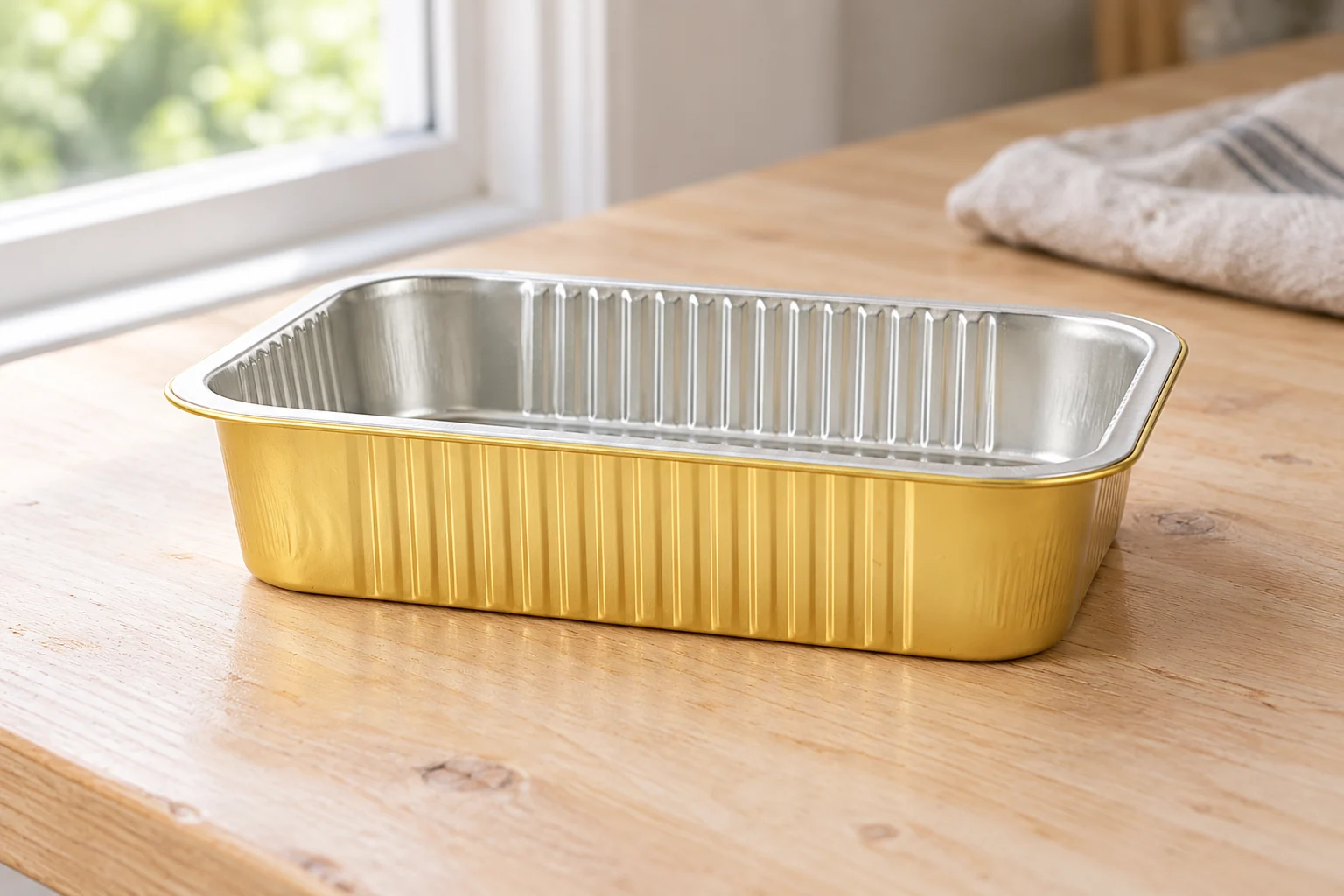
“Aluminum foil container” is a useful catalogue description, but an order may contain several separately specified items. A tray supplied alone is a different purchasing configuration from the same tray with a clear lid, a sealing film or a printed sleeve. Photograph the proposed pack with its components separated, and give each item a reference that also appears in the quotation.
For example, consider two quotations for a tray that looks identical. One includes a lid; the other supplies the tray only. A document describing the tray cannot, by its title alone, settle questions about the additional lid. This is a comparison example, not a description of an actual tested FirstAlu combination.
A simple component map helps:
- Tray: exact model, and whether the supplied version has a coating
- Lid or sealing film: its own material and product reference
- Printed sleeve, label or carton: where it sits in the assembled pack
- Supporting file: the component reference and intended use it actually identifies
What does a “free from” statement cover?
Before comparing claims, ask what the supplier means. Does the statement concern BPA specifically, a named set of phthalates, or something else? Is it about an ingredient declaration, a laboratory result or a statement limited to one component? These are questions to resolve in the evidence, not interchangeable labels to copy into a product listing.
Keep the original wording with the document reference. If a report says that a substance was not detected, ask the qualified reviewer to explain the method, applicable detection or quantification limit, and tested sample. Do not rewrite that result as an unlimited promise about every production batch, every component or every possible use. Equally, the absence of a document in the first email does not itself prove that a substance is present.
The useful outcome is a scoped statement: a named document refers to a particular item, under specified conditions. If the scope remains unclear, leave the claim out of customer-facing copy until it has been resolved.
Destination matters: distinguish the EU from Canada
The European Commission’s food-contact legislation overview distinguishes general rules from material-specific measures. Its December 2024 BPA announcement concerns an EU measure, not a worldwide rule. Have the applicable scope and current provisions checked for the actual destination and component.
For Canada, Health Canada explains that a letter of no objection is not legal approval and relates to specified applications. Do not treat it as a blanket certificate covering an entire product range or replace a Canadian review with an EU document solely because both concern food packaging.
These background references do not establish that a particular supplier’s pack complies. Europe also includes destinations outside the EU. Write the country and intended application into the review brief instead of relying on a regional label.
Match the document to how the pack will be used
Health Canada’s submission guidance links material identity with proposed use. For a purchasing review, record the food, contact duration, temperature and handling conditions before asking whether the evidence is relevant.
Describe what actually happens: filling, storage, transport and any intended reheating. Do not choose an oven or microwave limit from an unrelated tray photograph, a competitor’s page or a general article. Where a lid is removed before a particular step, include that instruction in the description rather than assuming everyone uses the pack the same way.
Keep unresolved details visible. If the customer has not chosen the lid, the file is not yet a review of the final assembled pack. Mark the missing choice and return to it before approving the relevant claim or instruction.
Three common questions
Does “BPA-free” establish complete food-contact suitability?
That phrase alone does not identify every component, the intended use or the basis of the statement. Review the complete file rather than using one claim as the conclusion.
Can the same paperwork be used with a different lid?
First check whether the new lid is within its stated scope. Matching dimensions or a similar appearance does not establish that the document covers it.
What should I do if the documentation is incomplete?
List the missing component references and questions clearly. Ask the supplier to clarify them and obtain appropriate specialist review before relying on an unresolved safety or compliance claim.
For a question about a specific FirstAlu pack, you can contact the team with the tray reference, lid choice and destination. That provides a useful starting point without implying that a general article can approve the product.