

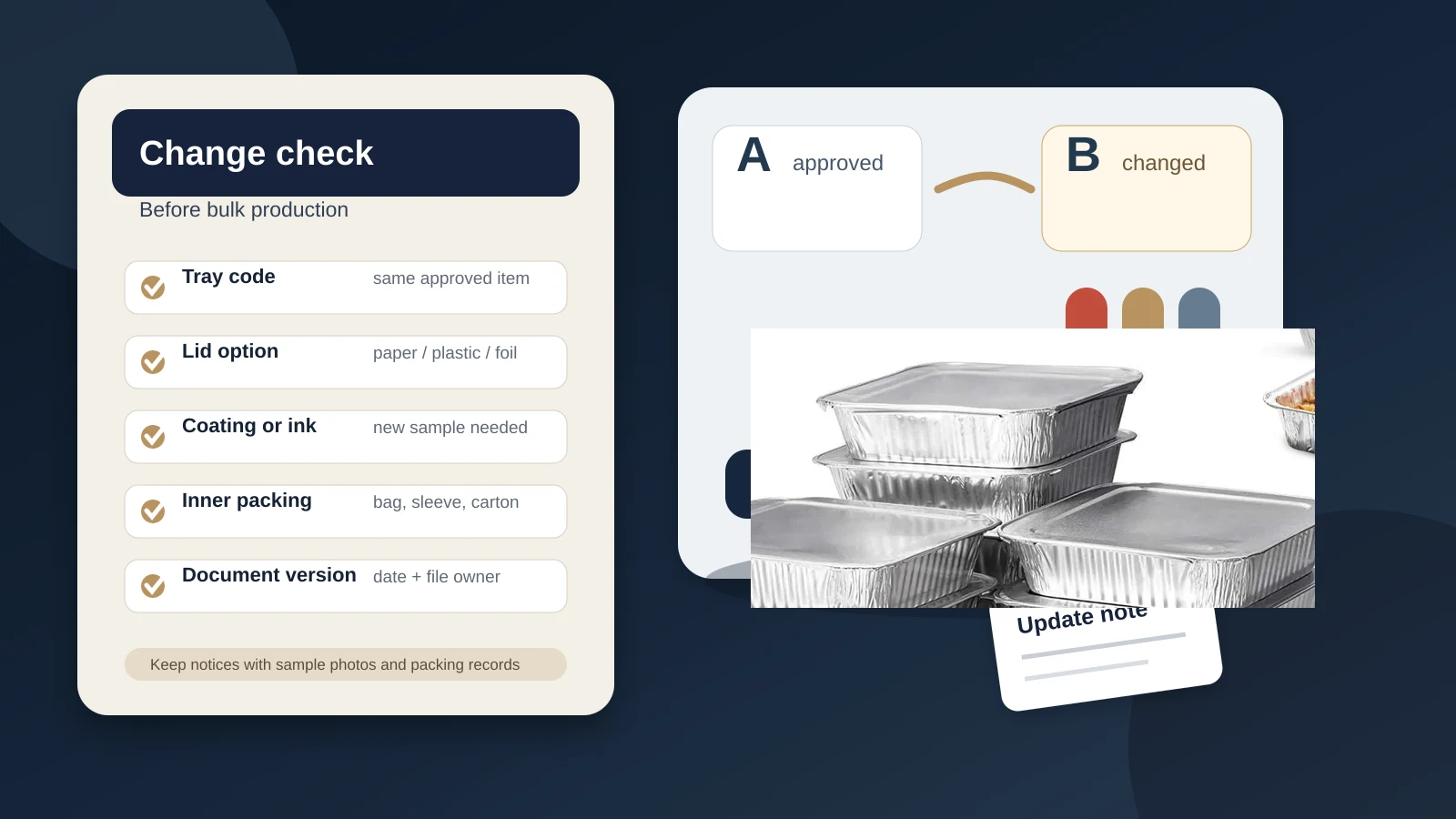
A food-contact file is not finished when the first sample is approved. Importers buying aluminum foil containers should also know what happens when the supplier changes a lid, coating, inner bag, ink, carton, or production detail later. Those changes can affect the sample record, customer approval file, and the documents your team keeps for food-contact review.
Ask the supplier for a simple change-control rule before bulk production: if the tray, lid, coating, printing, packing, or food-contact document changes, the supplier should notify you before the order ships. Keep the notice with photos, sample dates, packing records, and the updated quotation line.
Why change control matters for packaging buyers
Food packaging importers often collect certificates and test reports during onboarding, then forget to ask what happens after the first order. That is risky. Packaging is not one fixed thing forever. A buyer may approve one tray with a paper lid, then later order the same tray with a plastic lid, a different inner bag, or a retail sleeve. A supplier may also adjust packing to meet carton count or freight requirements.
Recent food-contact news keeps pointing in the same direction: regulators and industry groups are paying closer attention to food-contact materials, recycled or alternative materials, and post-market reviews. That does not mean every aluminum foil tray order has a new legal problem. It does mean importers should keep cleaner records when product details change.
For related product context, see FirstAlu's aluminum foil containers, smoothwall containers, and wrinklewall containers.
What changes should trigger a supplier notice?
Start with the changes that can confuse a buyer's food-contact or customer file. The supplier does not need to send a long legal memo. A short written notice with photos and updated data is usually more useful.
Ask for a notice before these changes:
- Tray size, shape, rim style, or item code.
- Foil thickness, temper, or material specification used for the container body.
- Lid type, including paper, aluminum, plastic, or sealing film.
- Any coating, lacquer, printing ink, label, or sleeve that may sit near the food-contact pack.
- Inner bag, retail box, paper band, carton liner, or other direct packing material.
- Carton count, packing method, carton mark, or pallet packing if the customer file uses those details.
- Factory, production line, or subcontracted process when that detail appears in your approved supplier file.
Do not treat all changes as equal. A carton-size update may matter for logistics and EPR records. A lid-material change may matter for food-contact review and customer approval. A printed retail sleeve may matter for label artwork, claim wording, and shelf presentation.
How should importers write this into an RFQ?
Put the rule in plain English. Buyers sometimes ask for "all compliance documents" and expect the supplier to understand the full workflow. A better RFQ line is more direct:
Please notify us before production if there is any change to tray material, lid material, coating, printing, inner packing, carton packing, food-contact documents, or the factory/process used for the approved item.
Then attach your own template if your customer has one. If you do not have a template, use a small table with five columns: change item, old version, new version, reason, and supporting photo or document. This is enough for most sourcing files and easier for a factory team to complete.
The point is not to make the supplier responsible for your local legal filing. The point is to stop silent substitutions. If your customer approved one sample, your order file should show whether the shipped goods still match that sample.
Which records belong in the change-control file?
Keep the file practical. Importers do not need a binder full of vague certificates if no one can match them to the ordered item. Save records that connect the exact SKU to the approved sample and shipment.
Useful records include:
- Original quotation and item code.
- Approved sample photos, including tray, lid, inner packing, and carton mark.
- Food-contact declaration or test report referenced for that item, where available.
- Updated supplier notice when a component changes.
- Photos of the new sample or revised packing.
- Packing list and carton data for the shipped order.
- Buyer approval email or internal note confirming acceptance of the change.
Use version dates. For example: C320 tray with paper lid, sample approved 2026-05-30, carton packing version 1. If the lid changes later, create version 2 instead of overwriting the old file. This small habit prevents a lot of confusion when a retailer asks what was shipped six months ago.
For wider procurement checks, keep quality certifications, the buyer FAQ, and the supplier profile in the same buyer review path.
What about recycled or alternative food-contact materials?
Do not copy claims from another material into your aluminum foil container file. News about recycled plastics, alternative food-contact materials, or harmonized regulation may be relevant to the wider packaging market, but each material still needs its own evidence and wording.
If a supplier offers a recycled-content claim, a new coating, a new lid material, or a new inner bag, ask what changed and what proof supports the claim. Keep the answer factual. Material, weight, supplier statement, test report reference, and sample photos are more useful than broad words like green, eco, or compliant.
For aluminum foil containers, many importer files are strongest when they stay close to the product facts: alloy or material description, thickness, tray size, lid option, coating if used, packing method, and matching food-contact documents. If your customer wants a sustainability claim, ask the customer what evidence they require in that market before adding the wording to artwork or sales sheets.
How to check a change before approving production
A supplier notice is only useful if someone checks it. Before bulk production, compare the new detail against the approved sample and order requirement.
Use a short review process:
- Confirm whether the change affects food contact, packing, label artwork, or only logistics.
- Ask for clear photos of the changed part and the full product set.
- If the lid or coating changes, request an updated sample where practical.
- Match the changed item to the quotation, proforma invoice, and packing plan.
- Save the buyer's approval before production starts.
If the change is minor, the review may take one email. If the change affects food contact or customer artwork, slow down. It is cheaper to wait for a sample than to explain a mismatch after the goods arrive.
FAQ
Is change control the same as asking for food-contact certificates?
No. Food-contact documents show what the supplier can support for a material or product. Change control tells you when the approved product or packing has changed, so you know whether the existing documents and samples still match the order.
Should every carton packing change be treated as a compliance issue?
No. Some carton changes are mainly logistics issues. Still, importers should record them when carton count, carton dimensions, packing materials, or carton marks are used in customer files, EPR records, or warehouse setup.
What should buyers do if the supplier changes a lid material?
Treat it as a new review point. Ask for the lid material, sample photo, unit weight if needed, and any food-contact support available for that lid. Do not assume a paper lid, plastic lid, aluminum lid, and sealing film share the same record.
Can the supplier decide whether a change is legally acceptable in the destination market?
The supplier can provide product facts and documents. The importer, brand owner, distributor, or local seller usually needs to confirm destination-market obligations with its own compliance team or adviser. Keep the supplier's role factual.
Bottom line for importers
A clean change-control process protects the buyer as much as the supplier. Write the notice rule into the RFQ, record the approved sample version, and ask for an update when tray material, lid material, coating, printing, inner packing, carton packing, or food-contact documents change.
If you are preparing an aluminum foil container order, send FirstAlu your tray size, lid option, use condition, destination market, packing preference, and any customer change-notice template. The team can help keep the product and packing details clear for your review.