
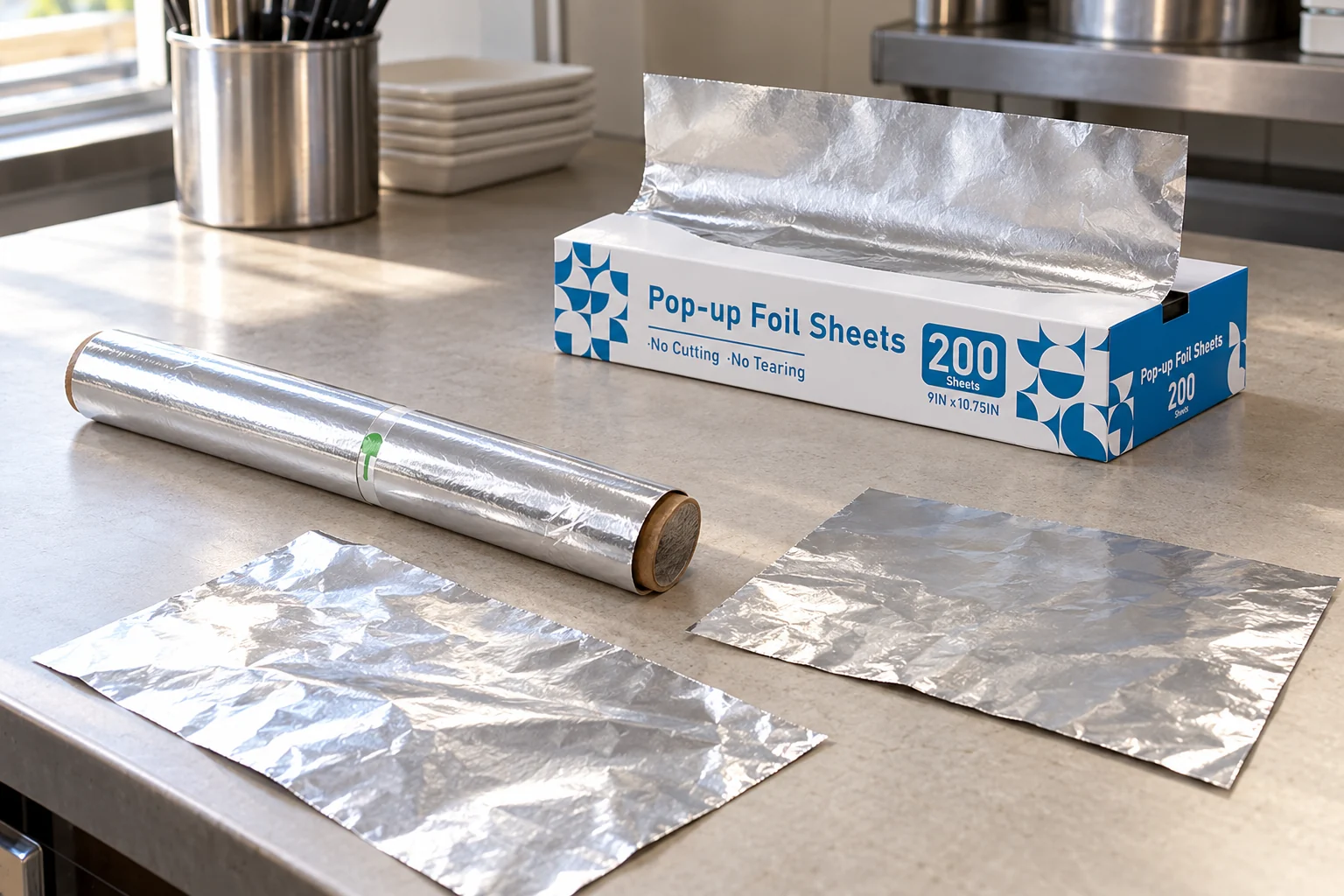
A sheet dispenser removes the choice of cut length. That can suit a repeated wrapping job, but a fixed sheet that is too small may require two pieces, while an oversized one leaves unnecessary material around every portion. A roll offers adjustable length within its fixed width. Reynolds describes the same basic format distinction for its products. Manufacturer reference
Measure a successful wrap, not just the food
Start with one representative item. Establish the rectangle needed to wrap or cover it, including the overlap and folds your method requires. For a tray, the top opening alone is not the required sheet size: the material must also reach the intended closure points. Use the actual product instructions and confirm that the foil is suitable for the food and use.
Record width and length in the same units. Rotate a sample if that helps, but check both dimensions. Equal area does not mean equal fit: a long narrow sheet may have enough total area and still fail to cover the tray.
A purely illustrative coverage calculation
Suppose a wrapping method needs a 30 × 25 cm rectangle, already including its folds. A hypothetical 30 × 30 cm sheet supplies 900 cm²; the required rectangle uses 750 cm². The remaining 150 cm² is 16.7% of the issued sheet area. It is potential excess, not automatically discarded waste: your actual fold may retain it.
A hypothetical 30 cm-wide roll cut to 25 cm supplies 750 cm² before cutting errors. For 100 successful wraps, the idealized totals are 9 m² of fixed sheets versus 7.5 m² from the roll. Neither number predicts actual consumption, labor or environmental impact.
Now change the job to a cover needing 40 × 35 cm. The 30 × 30 cm sheet does not fit, even when rotated. A 45 cm-wide roll cut to 35 cm provides one piece, with 5 cm of excess width. Do not assume overlapping two sheets makes an equivalent closure. If the application cannot accept a join, select another size or format.
Run a fair workstation trial
Test both formats on the same mix of jobs and comparable batches. Keep the dispenser in its intended configuration, follow its setup instructions and use a location where staff can reach it without moving the food each time. Do not modify the cutter or mount a dispenser in an undocumented way.
For each batch, record completed wraps, sheets or roll length issued, torn pieces, duplicate pulls, recuts, refills and total working time. Separate unused offcuts from foil retained on the finished pack. Record jams and awkward reaches rather than assuming one-handed dispensing makes the process faster or more hygienic.
Make a job-specific choice
A fixed size may suit the repeated sandwich and fail the changing tray sizes. Keeping two formats can be reasonable if the measured benefit justifies extra stock and bench space. Choose using material per successful wrap and the observed work sequence, then repeat the trial when portion sizes or packaging change.

