

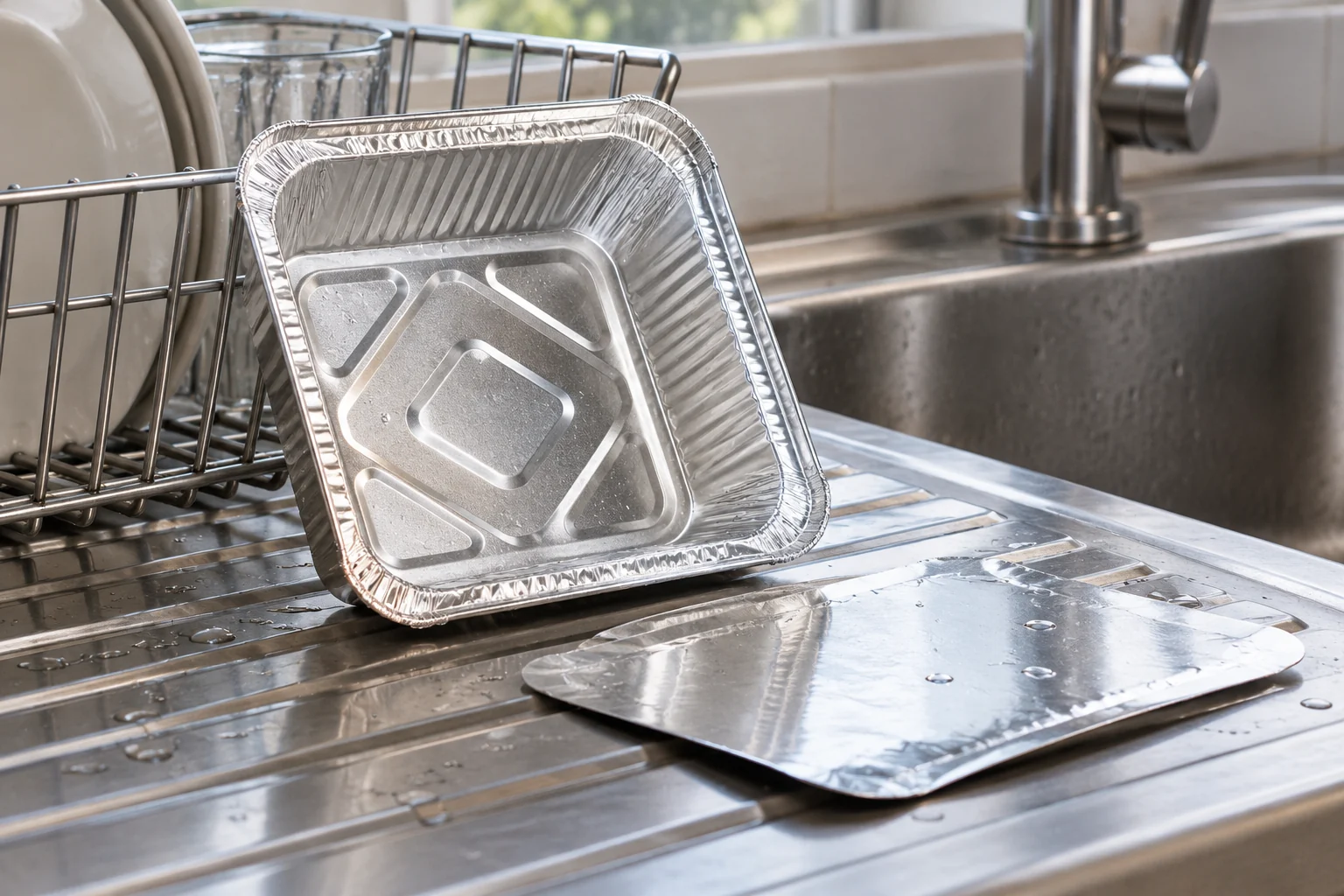
“Aluminum is recyclable” does not tell a customer which bin to use for a takeaway package. A useful disposal instruction identifies the tray, its other components and the collection service where the meal will be eaten. Start there before describing a delivery pack as environmentally preferable.
Four questions that mean different things
- Material recyclability: can the material be reprocessed through an appropriate recycling process?
- Local collection: does the relevant service accept this item, prepared as instructed?
- Recycled content: how much recovered material went into manufacturing this particular product?
- Life-cycle impact: what environmental burdens arise across the defined life cycle and comparison?
An answer to one question does not establish the others. A collection list is not evidence of a tray’s recycled content. Nor does putting something in a recycling bin prove it will become a new product. Avoid turning a general recycling benefit into a claim that every delivery tray has a lower footprint.
Build a component list
Set out an unused pack and identify the metal tray, lid, film, paper sleeve and any removable insert. Record the actual materials from product information; do not identify a shiny layer as metal just by looking at it. Check each component against the local service’s item guidance.
Separate or retain components as that service instructs. Do not assume the tray’s acceptance covers a coated paper lid, plastic film or liner. An unverified component stays an open question, not an automatic addition to the recycling stream.
Two local examples, not continent-wide rules
The City of London, England, lists foil and food trays in its household recycling collection and requires rinsing. City of London guidance This means the City’s service, not all London boroughs or Europe.
Calgary, Canada, lists foil trays and takeaway containers; foil that cannot be cleaned of heavy food soiling goes in the black cart. Calgary guidance Check the linked preparation directions for your item. These household examples do not establish a restaurant’s commercial waste contract or rules elsewhere in Canada.
Turn the check into usable instructions
Before writing a label or delivery-page note:
1. Confirm the customer’s municipality and collection service, including any building-specific arrangement. 2. Find the current entry for the exact item type, not just “metal.” 3. Record its preparation and component-separation directions. 4. Add a direct link, the area covered and the date checked. 5. Recheck when the packaging or collection service changes.
A hypothetical instruction template is: “For [service area], prepare this tray by [verified steps] and place it in [accepted stream]. Handle the lid by [verified instruction]. Check [official link] for updates.” Fill every bracket from the relevant guidance before publishing. If acceptance is unclear, ask the collection service rather than inventing a sorting rule.
Keep environmental claims specific
A recycled-content claim needs product-specific documentation stating the amount, calculation basis and component covered. This article establishes no recycled-content percentage for FIRSTALU products.
A comparative footprint claim needs a relevant life-cycle assessment with the same delivered-meal function and clear boundaries. Consider the whole pack, production, transport and end-of-life assumptions; collection guidance alone cannot provide that comparison. There is no universal energy-saving figure or environmental ranking here.
The practical result is a short, locally accurate disposal note and a list of unresolved components. That gives a customer something they can do after the meal without promising an outcome the packaging supplier cannot verify.
