
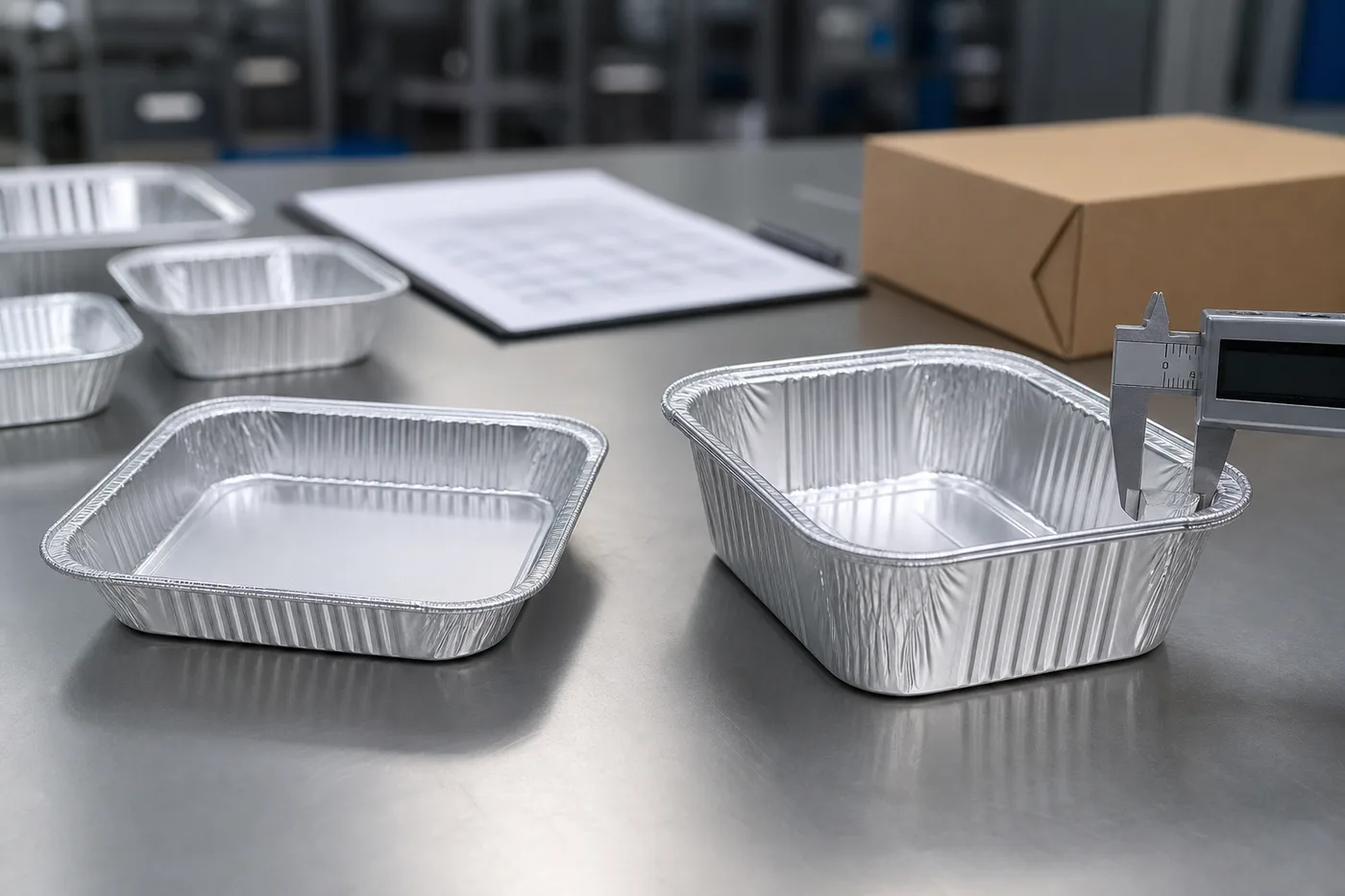
Les importateurs ne devraient pas demander « la barquette en aluminium la moins chère » en laissant le fournisseur deviner l’épaisseur. Une meilleure demande de prix précise le type d’aliment, les dimensions de la barquette, le couvercle, le conditionnement et les manipulations auxquelles elle devra résister. Le fournisseur peut alors recommander une épaisseur adaptée et envoyer des échantillons correspondant à la commande réelle.
L’épaisseur n’est pas qu’un chiffre sur un devis. Elle modifie la sensation en main, l’empilage, la fermeture du bord avec un couvercle et la tenue pendant le remplissage, le transport et la présentation en magasin. L’objectif n’est pas d’acheter systématiquement la barquette la plus épaisse, mais d’éviter une barquette mal spécifiée qui paraît correcte en photo et se déforme trop facilement à l’usage.
Pourquoi préciser l’épaisseur dans la demande de prix
De nombreux projets de barquettes en aluminium commencent par une demande de dimensions : longueur et largeur en partie haute, dimensions du fond, hauteur et capacité. Ces éléments comptent, mais ne décrivent pas entièrement la barquette. Deux contenants peuvent se ressembler en photo et offrir une tenue différente parce que l’épaisseur, l’état métallurgique de l’alliage, la conception des parois, le profil du bord et le motif de gaufrage diffèrent.
Si l’épaisseur manque dans la demande de prix, le fournisseur doit chiffrer d’après son expérience ou l’option la moins coûteuse. Cela peut suffire pour une première estimation, mais reste risqué avant une commande en volume. L’acheteur peut comparer plusieurs prix sans se rendre compte que les échantillons ne sont pas équivalents.
Pour les distributeurs de la restauration et les acheteurs à marque de distributeur, les erreurs deviennent alors coûteuses. Une barquette trop légère peut se déformer pendant le conditionnement. Une barquette inutilement lourde peut augmenter le coût et le poids des cartons sans améliorer l’usage du client. Une demande de prix précise garde la discussion concrète.
Ce qu’il faut décrire avant de demander une épaisseur
Avant de demander une recommandation d’épaisseur, décrivez la fonction du contenant.
- Type d’aliment : produits secs de boulangerie-pâtisserie, plats en sauce, aliments gras, plats surgelés, repas chauds à emporter, présentation réfrigérée en magasin ou restauration
- Poids de remplissage : poids approximatif des aliments par contenant, et pas seulement la capacité
- Conditions thermiques : remplissage à chaud, four, congélation, réchauffage ou simple couverture pour la vente à emporter
- Fermeture : couvercle en carton, en plastique ou en aluminium, scellage par film ou absence de couvercle
- Parcours de manutention : livraison de la cuisine au client, rayon de supermarché, transport de traiteur ou distribution à l’export
- Conditionnement : pièces par sachet plastique, carton intérieur, carton principal, chargement sur palette et éventuel transport longue distance
Ces informations aident le fournisseur à déterminer si la barquette nécessite davantage de rigidité, un bord plus résistant, des parois plus profondes ou un système de couvercle adapté. L’épaisseur seule ne résout pas tous les problèmes, mais c’est l’une des premières spécifications à confirmer.
L’épaisseur, la résistance du bord et la conception agissent ensemble
Les acheteurs parlent parfois de l’épaisseur de l’aluminium comme si elle définissait tout le produit. En pratique, elle n’est qu’un élément de sa structure.
Une barquette à parois plissées peut paraître plus ou moins résistante selon la hauteur des parois, les nervures, le rayon des angles et le bord roulé. Une barquette à parois lisses peut demander d’autres vérifications, car elle sert souvent à soigner la présentation, le scellage ou les packs de vente. Une barquette peu profonde pour pâtisserie n’a pas forcément besoin de la même structure qu’une barquette profonde contenant un plat lourd et humide.
Le bord est particulièrement important. S’il est trop souple, les couvercles peuvent s’ajuster de façon irrégulière et les piles devenir instables. S’il est bien formé, une épaisseur modérée peut convenir à l’usage prévu. C’est pourquoi il faut tester ensemble la barquette et le couvercle réels, au lieu d’approuver l’épaisseur à partir de la seule fiche technique.
Comment comparer les échantillons des fournisseurs
À la réception, ne vérifiez pas seulement si la taille paraît correcte. Faites subir aux échantillons les mêmes manipulations qu’en situation réelle.
Commencez par un contrôle visuel. Vérifiez la qualité du formage, la régularité des bords, la stabilité des angles et la constance de la forme des parois. Testez ensuite l’ajustement du couvercle correspondant. Il doit se placer correctement sans forcer le bord à se déformer. Si le projet utilise un film de scellage, demandez les conditions de scellage envisagées et faites un essai sur votre propre équipement lorsque c’est possible.
Effectuez ensuite un test simple de manipulation. Remplissez la barquette avec un poids réaliste d’aliments ou une charge de substitution sans danger. Soulevez-la par les côtés, empilez quelques barquettes remplies si cela fait partie de l’utilisation, puis placez-les dans le carton prévu. Surveillez les déformations, les couvercles qui se détachent, les angles endommagés et les empilages instables.
Pour les packs de vente ou à marque de distributeur, examinez l’aspect après manipulation. Une barquette peut contenir les aliments tout en paraissant trop fragile pour une gamme haut de gamme. Pour la livraison ou la restauration, la tenue du couvercle et la déformation pendant le transport peuvent être prioritaires.
Ce qu’un chiffre d’épaisseur ne permet pas de conclure
Ne supposez pas qu’une épaisseur supérieure constitue automatiquement un meilleur achat. Pour un aliment léger et un usage simple, une barquette plus lourde peut ajouter du coût sans grand bénéfice. Si les aliments sont lourds, gras, humides ou empilés pendant le transport, une barquette fine à bas prix peut entraîner des réclamations plus coûteuses que la petite économie réalisée.
Ne comparez pas les épaisseurs sans comparer la conception. Un autre moule, un autre motif de nervures, un profil de bord différent ou un autre état métallurgique de l’alliage peuvent modifier les performances. Demandez aux fournisseurs de chiffrer les mêmes dimensions et le même usage, puis comparez les échantillons avec le même essai.
Ne prenez pas une photo pour une preuve. Les images en ligne montrent rarement la résistance du bord, la rigidité des parois ou l’ajustement du couvercle. Des échantillons restent nécessaires avant une commande importante.
Une formulation de demande de prix à reprendre
Une demande de prix utile n’a pas besoin d’être longue. Elle doit éliminer les principales suppositions.
- Nous recherchons des barquettes en aluminium pour [type d’aliment/application].
- Dimensions ou capacité souhaitées : [dimensions/capacité].
- Poids de remplissage approximatif : [poids par barquette].
- Conditions d’utilisation : [remplissage à chaud/congélation/four/réchauffage/livraison/présentation en magasin].
- Couvercle souhaité : [carton/plastique/aluminium/scellage par film/sans couvercle].
- Conditionnement demandé : [pièces par sachet/carton, palettisation si connue].
- Veuillez recommander une épaisseur d’aluminium adaptée et envoyer les échantillons correspondants pour approbation.
- Veuillez indiquer la quantité minimale de commande, les délais des échantillons et de la production en volume, les dimensions des cartons, le poids brut et les documents de contact alimentaire disponibles.
Ces informations donnent au fournisseur suffisamment de contexte pour recommander une option réaliste. Elles rendent aussi la comparaison plus équitable, chaque devis reposant sur la même application.
Les documents et la conformité restent importants
L’épaisseur concerne les performances du produit. La conformité pour le contact alimentaire constitue une vérification distincte. Le bulletin sectoriel FirstAlu du 2026-05-24 a de nouveau signalé des sources officielles sur le contact alimentaire et la réglementation des emballages, notamment les recommandations FDA sur les substances au contact des aliments et les pages de la Commission européenne sur les matériaux au contact des aliments et les déchets d’emballages. Ces sources rappellent l’intérêt de conserver documents et spécifications produit dans le même dossier d’achat.
Pour les barquettes en aluminium, demandez quels documents de contact alimentaire le fournisseur peut fournir pour le marché et le type de produit concernés. Si la commande comprend des couvercles, des revêtements, des emballages imprimés ou des étiquettes de vente, intégrez-les également à l’examen documentaire. Ne validez pas uniquement les essais de la barquette en laissant le couvercle, l’étiquette ou la maquette du carton sans confirmation.
Quand demander une barquette plus résistante
Il est généralement utile d’en discuter lorsque le contenant doit supporter des aliments lourds, des sauces, de longs trajets de livraison, une forte pression d’empilage ou de nombreuses manipulations en magasin. Une résistance accrue peut aussi être nécessaire lorsque le pack doit paraître rigide en rayon ou que la fermeture dépend d’un bord stable.
Une barquette plus légère peut néanmoins convenir aux aliments secs et légers, aux trajets courts ou aux faibles hauteurs d’empilage. Le choix dépend de l’usage, et non d’une épaisseur universelle.
En cas de doute, demandez deux échantillons : l’option standard recommandée et une option plus résistante. Testez-les avec le même poids d’aliments et le même couvercle. Le meilleur choix apparaît souvent après cinq minutes de manipulation.
FAQ
Quelle épaisseur choisir pour des barquettes en aluminium ?
Aucune épaisseur ne convient à tous les projets. Précisez au fournisseur le type d’aliment, le poids de remplissage, les dimensions, la fermeture, les conditions thermiques et le trajet de transport, puis testez les échantillons avant de confirmer la commande en volume.
Une barquette en aluminium plus épaisse est-elle toujours meilleure ?
Non. Elle peut paraître plus résistante, mais aussi augmenter le coût et le poids des cartons. Choisissez une barquette adaptée à l’aliment et aux manipulations réels.
Puis-je approuver une commande en volume uniquement sur photos ?
Non. Les photos ne prouvent ni la résistance du bord, ni l’ajustement du couvercle, ni l’empilabilité, ni la tenue à la manipulation. Demandez des échantillons physiques et testez-les avec un poids de remplissage réaliste.
Que faut-il inclure dans une demande de prix de barquettes en aluminium ?
Indiquez les dimensions, le type d’aliment, le poids de remplissage, les conditions d’utilisation, le couvercle souhaité, les exigences de conditionnement, le marché cible, la demande d’échantillons et les documents de contact alimentaire nécessaires.