
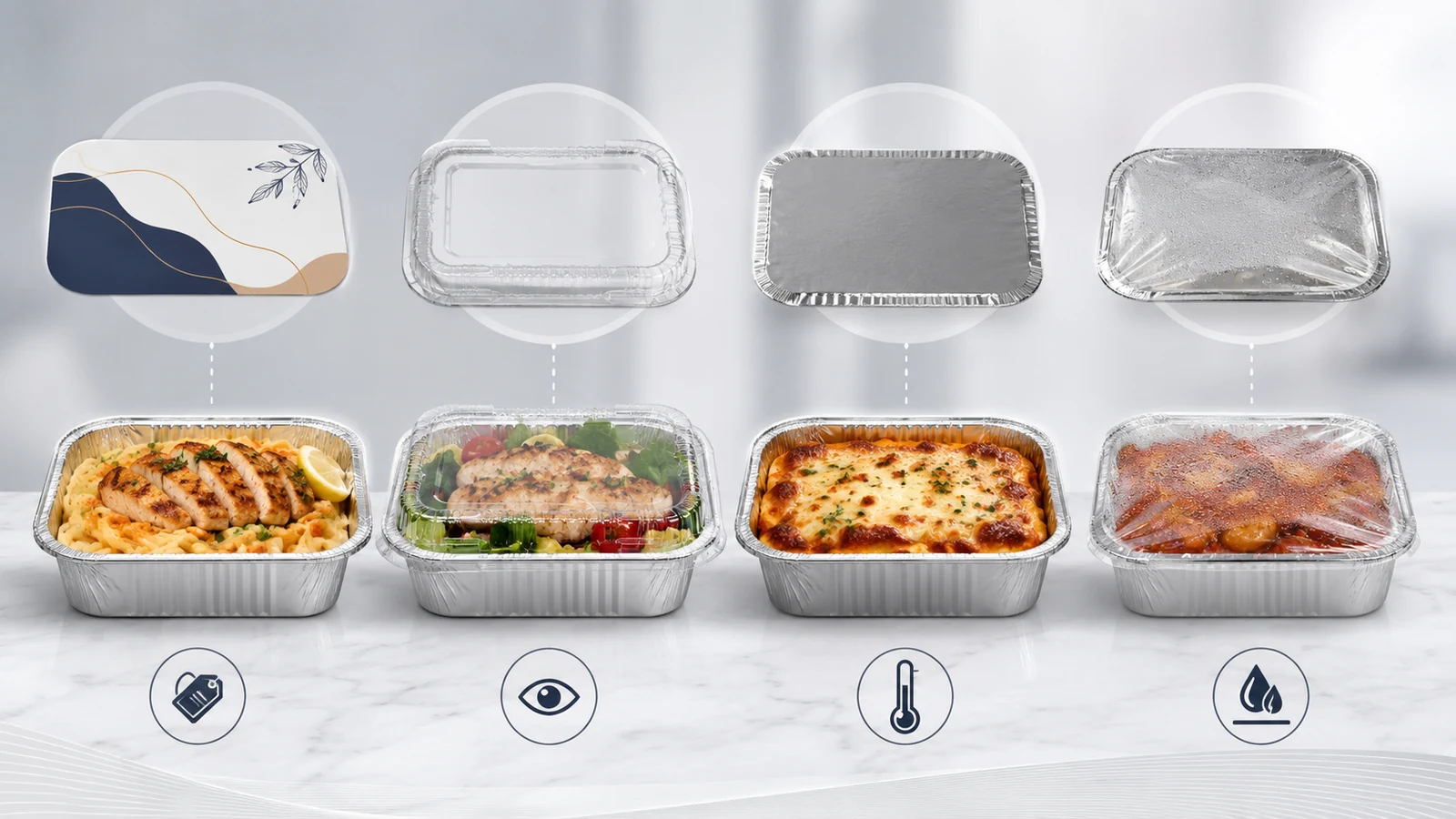
A foil tray is only half of the package. The lid decides how the meal looks on the shelf, how well it travels, how staff handle it during service, and what the customer can do with it after purchase.
That is why lid choice should not be left until the end of a sourcing project. A strong tray with the wrong lid can still leak in a delivery bag, lose its shape in a stack, hide the food when the buyer needs display visibility, or block the branding space that a private-label program depends on.
For importers, distributors, airline meal suppliers, caterers, and prepared-meal brands, the practical question is not simply paper or plastic. Buyers usually need to compare paper lids, plastic clip-on lids, aluminum foil lids, and sealing film as different systems. Each one changes cost, packing, heat use, presentation, and customer instructions.
This guide explains how to choose foil container lids before placing a bulk order.
Start with the job the lid must do
Before comparing materials, define the job. A lid may need to cover food for takeaway, protect chilled meals in a display case, support stacking during transport, show the food clearly, carry printed branding, or seal a ready meal for distribution.
Those are different requirements. A lid that works for a hot rice meal may not be right for a retail salad tray. A lid used only as a dust cover is different from a lid expected to survive courier delivery. A printed paper lid for a premium meal program has a different purpose from a transparent lid for grab-and-go display.
Buyers should describe the full use case before asking for a price:
- Food type and portion weight
- Hot, chilled, frozen, or ambient use
- Delivery, catering, retail display, airline meal, or ready-meal use
- Whether customers need to see the food before purchase
- Whether the lid needs printing or private-label branding
- Whether reheating is expected
- Whether leak resistance or tamper evidence matters
- Carton packing and stacking requirements
The best lid is the one that fits the food, route, brand, and handling method.
Paper lids: best when branding and presentation matter
Paper lids are often chosen when the buyer wants a clean top surface for printing, product names, heating instructions, brand color, or a more natural look. They are a strong option for takeaway meals, private-label prepared foods, catering packs, and foodservice projects where the package needs to communicate.
A paper lid can make a standard foil container feel more organized and retail-ready. It can also help staff identify meals quickly when several dishes use similar tray sizes.
Paper lids are usually a good fit when:
- Logo printing or meal names are important
- Food visibility is less important than brand presentation
- The tray is used for takeaway, catering, or prepared meals
- The buyer wants a flat surface for labels or instructions
- The pack should look less industrial than plain foil
The main limitation is visibility. If the customer must see the food through the lid, paper is not the best choice unless the design includes a window. Buyers should also confirm whether the paper lid is only for covering, whether it supports stacking, and how it behaves with steam from hot food.
Plastic clip-on lids: best when visibility matters
Plastic clip-on lids are often selected because the food remains visible. That matters for chilled display, deli counters, supermarket prepared meals, bakery items, salads, and any project where appearance helps the product sell.
Clear lids also help operators check orders without opening the pack. For catering kitchens and takeaway operations, that can reduce mistakes during busy service.
Plastic lids are usually a good fit when:
- Customers need to see the food
- Staff need quick visual checking
- The pack is used for chilled display or ready-to-go meals
- Strong tray-lid fit is needed for handling
- Branding can be handled with labels, sleeves, or carton design
The key point is temperature. Buyers should not assume every plastic lid is suitable for hot food, oven use, or microwave reheating. The tray may handle heat, while the lid may not. Confirm the resin, temperature limit, use instructions, and whether the lid is for transport only.
Aluminum foil lids: best for heat and barrier needs
Aluminum foil lids are useful when heat resistance, barrier performance, or full foil packaging is required. They are common in some airline meal, catering, baking, freezer, and ready-meal applications.
A foil lid can help protect food from light, moisture, and external contamination. It also keeps the package in a metal-based material family, which may simplify some buyer specifications. For certain high-heat or oven-related uses, foil lids can be more practical than plastic lids.
Foil lids are usually worth checking when:
- Heat resistance is important
- The food may be frozen, chilled, or oven reheated
- The buyer does not need food visibility
- A stronger barrier is useful
- The project uses institutional, airline, catering, or ready-meal trays
Buyers should confirm whether the foil lid is a loose cover, a crimped lid, or part of a sealing structure. Small differences in rim design can change how secure the lid feels after closing.
Sealing film: best for ready meals and controlled packing lines
Sealing film is different from a loose lid. It is normally used with suitable trays and sealing equipment. The goal is a cleaner, more controlled pack for ready meals, chilled meals, frozen meals, and some industrial foodservice programs.
Film sealing can improve presentation and reduce lid movement because the seal is applied directly to the tray rim. It may also support modified atmosphere packaging or tighter process control when the buyer has the right production line.
Sealing film is usually a better fit when:
- The buyer has tray sealing equipment
- The project needs ready-meal style presentation
- Leak reduction is a priority
- Shelf life or process control matters
- The tray rim is designed for sealing
It is not the simplest option for every buyer. Sealing film requires compatible tray design, sealing temperature, machine setup, and film specification. For small operators or basic takeaway use, a matched lid may be easier.
Lid fit matters more than the material name
Many sourcing problems start when a buyer chooses a lid by material name but does not confirm fit. A lid must match the tray rim, shape, dimensions, and closing method.
A mismatch can create problems such as:
- Lids popping off during delivery
- Steam pressure lifting the cover
- Stacked meals pressing into the lid below
- Sauce leaking at the corner or rim
- Cartons becoming harder to pack efficiently
- Customers receiving unclear reheating instructions
For foil containers, the rim design is especially important. Smoothwall trays, wrinklewall trays, round trays, rectangular trays, and compartment trays may need different lid structures. Buyers should ask the supplier to confirm the exact tray and lid pairing, not only the general size.
Match lid choice to the food
Different foods stress the lid in different ways. Oily food, sauced food, grilled meat, rice meals, bakery products, salads, and frozen meals do not behave the same in transit.
For hot sauced meals, the buyer should check steam, lid lift, leakage, and whether the lid softens. For chilled display meals, visibility and condensation may matter more. For catering trays, stacking strength and handling are often more important than retail appearance. For ready meals, seal integrity and customer reheating instructions become central.
A simple way to decide is to test the worst menu item, not the easiest one. Use the heaviest, hottest, oiliest, or most liquid food in the range. If the lid works there, the buyer has a much better basis for bulk ordering.
What buyers should test before ordering
Sample testing should copy real service conditions. Empty trays and room-temperature water tests are not enough.
A useful test includes:
- Fill the tray with the actual food
- Close the lid the way staff will close it during service
- Hold the pack for the normal delivery or display time
- Stack filled packs if stacking happens in real use
- Tilt the pack gently to check rim leakage
- Check condensation, lid lift, staining, and food appearance
- Test any reheating instruction only with the correct lid material
- Confirm carton packing after choosing the lid
Buyers should record results with photos and notes. This makes supplier discussions much clearer and helps internal teams compare options.
What to include in a lid RFQ
A strong RFQ saves time. Instead of asking for a generic lid price, send the supplier the full packaging requirement.
Include:
- Tray model, size, capacity, and shape
- Food type and fill weight
- Hot, chilled, frozen, oven, or delivery use
- Preferred lid type: paper, plastic, foil, or sealing film
- Whether printing, labels, or private-label artwork are needed
- Whether food visibility is required
- Reheating or oven-use expectations
- Packing quantity per carton
- Destination market and documentation needs
- Sample quantity and testing plan
This prevents a common mistake: comparing two quotes that look similar but describe different lid performance.
How FirstAlu can help
FirstAlu supplies aluminum foil containers, smoothwall trays, wrinklewall trays, foil laminated paper lids, plastic clip-on lids, aluminum foil hood lids, and related food packaging options.
For buyers choosing a lid system, we can help compare tray-lid fit, food use, carton packing, branding needs, and sample testing before a bulk order. The most useful request includes the tray model, food type, target market, and whether the project needs visibility, printing, heat resistance, or sealing performance.
There is no universal best lid. Paper lids are strong for branding. Plastic lids are strong for visibility. Foil lids are strong for heat and barrier needs. Sealing film is strong for ready-meal production. The right choice is the one that protects the food and matches how the package will actually be used.
FAQ
Which lid is best for foil containers?
It depends on the use. Paper lids are usually better for branding and printed information. Plastic lids are better when food visibility matters. Foil lids are useful for heat and barrier needs. Sealing film is better for ready-meal lines with compatible trays and equipment.
Can plastic lids be used for hot food?
Some plastic lids may be suitable for warm or hot-fill handling, while others are cover-only or display-use products. Buyers should confirm resin, temperature limit, food contact suitability, and whether the lid can be used during reheating.
Can one foil tray work with different lids?
Often yes, but the fit must be confirmed. The same tray may have paper, plastic, foil, or sealing options, but rim design and tolerance determine whether the lid closes securely.
Are paper lids better than plastic lids?
Paper lids are better when branding, printing, and a cleaner top surface matter. Plastic lids are better when customers need to see the food. Neither is automatically better for every project.
What should buyers send before asking for a quote?
Send the tray size or model, food type, fill weight, lid preference, target use, order quantity, destination market, and whether printing or sealing is required.