
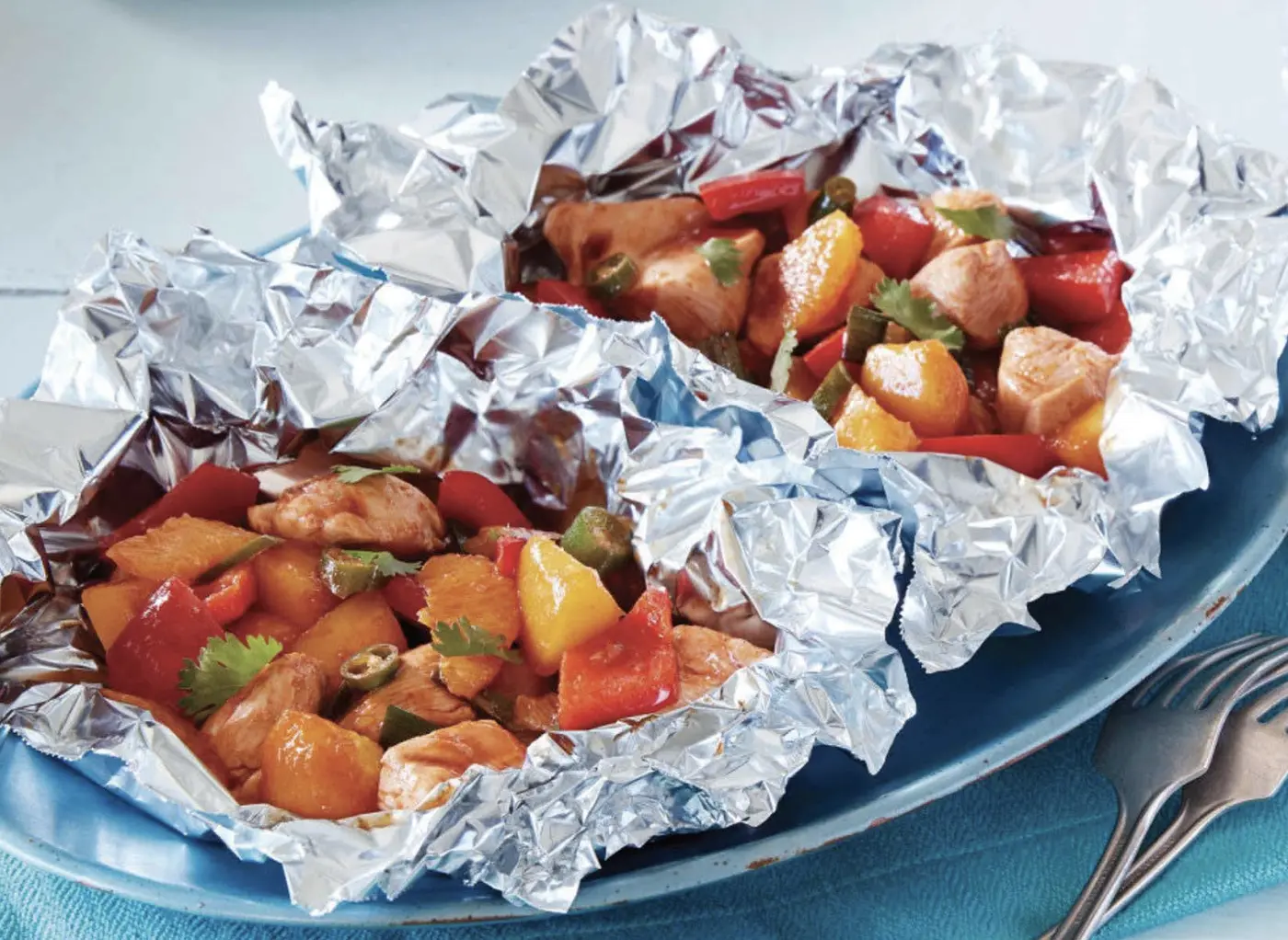

Foil can be shaped around food or over a dish, but a good wrapping choice starts with the food and what happens next. A sandwich for transport, leftovers for refrigeration and a meal intended for reheating need different checks. The shiny appearance alone does not establish suitability, a storage life or a heating instruction.
Use this sequence to decide whether your foil is appropriate and whether a container would be more practical.
1. Check what will touch the foil
Read the foil's food-contact and use instructions. Identify acidic or salty ingredients before wrapping. Germany's Federal Institute for Risk Assessment (BfR) advises against wrapping acidic or salty foods in aluminum foil. Choose packaging specified for those foods instead of assuming all foil resists them.
A sauce, dressing or marinade belongs in this check, even when the main ingredient appears dry. Do not infer a protective coating from the colour or finish. If a product is described as coated or non-stick, check that product's instructions rather than extending a claim from another foil.
2. Decide whether wrapping or a container fits the job
Try the empty packaging arrangement before filling it. Is the sheet large enough to close without stretching over a sharp edge? Will the food keep its shape, or does it need support? Will a container with a matching lid be easier to carry or store?
For example, a hypothetical sandwich order and a portion of loose food may need different arrangements even if their weights are similar. Treat the comparison as a fit check, not proof that either package is leak-proof or keeps food safe for a fixed number of hours.
3. Keep storage decisions separate from the wrapper
Health Canada's leftovers guidance recommends prompt refrigeration in uncovered, shallow containers while cooling, and dating stored leftovers. Follow the full guidance for cooling and storage; wrapping cannot replace those steps.
Plan the storage location and timing before you close the pack. Label the contents and date where that helps you identify it later. For a food business, use the storage instructions and records in your own food-safety procedure. Do not assign extra shelf life simply because a wrap looks tightly closed.
4. Read the side and coating instructions
For its own standard and heavy-duty foil, Reynolds says either side can face the food. Its non-stick version has a designated food-contact side. This illustrates why a finish is not a universal performance instruction; follow the label on your product.
If sticking matters, identify the actual non-stick product or choose a suitable alternative. A dull surface by itself is not a reason to call an unspecified foil non-stick.
5. Recheck before reheating
A wrapper used for storage is not automatically suitable for the appliance you plan to use next. Check the foil, any container or lid, and the appliance instructions together. Where the combination is not authorized, use a suitable alternative rather than improvising.
See the separate oven-use guide and microwave suitability guide for the relevant questions. Neither a reflective surface nor a tightly folded edge supplies an appliance approval.
Before finishing, ask: does this foil suit the food, does the pack support it, and is the storage or reheating plan clear? If one answer is missing, resolve it before using the pack.


